-
About UsHebei Runtian Water-Saving Equipment Co., Ltd. is a specialized, modern enterprise that integrates research and development, manufacturing, sales, and engineering installation of plastic irrigation products.

-
ProductsOur main products include: lateral labyrinth drip irrigation tape, inline patch-type drip irrigation tape, inline cylindrical drip irrigation tubing, inter-tube drip irrigation tubing, a wide range of sprinkler and micro-sprinkler accessories, drip arrows, pressure-compensated drippers, turbulent-flow small-tube emitter drip irrigation systems, PE water supply pipes in various models and specifications along with corresponding pipe fittings, PVC underground water conveyance pipes and PVC pipe fittings, filters, fertigation equipment, and other water-saving irrigation products and equipment for greenhouse cultivation, field farming, and micro-drip and micro-sprinkler irrigation.
-
BlogWe look forward to sincere cooperation with you, backed by stable and reliable quality, prompt delivery times, and superior after-sales service.
-
Qualifications
-
Cases
-
Contact Us
Sprinkler Irrigation Tape: Applications in Landscaping Projects
Release Date:
2021-10-09
Application of drip irrigation tape in landscaping projects: As project scale expands and construction progresses rapidly, localized water-supply challenges are inevitable—such as insufficient initial coverage of water sources, low efficiency of manual watering, poor soil water retention on site, reduced post-construction maintenance efficiency, and low water-use efficiency. The simple operation and cost-effectiveness of drip irrigation tape enable it to address vegetation-management issues in the early stages of a project, enhance seedling survival rates, improve management efficiency and aesthetic outcomes, and ensure timely project delivery and a positive public image.
Application of Drip Irrigation Tape in Landscaping Projects
As the scope of work expands and construction progresses rapidly, localized water-supply interruptions are inevitable. For instance, if the water source cannot be fully covered in the early stages, manual watering is inefficient; moreover, the site itself has poor water-retention capacity, leading to low maintenance efficiency and low water-resource utilization in the later phases.
Simple to operate and inexpensive—sprinkler irrigation tape can address vegetation management challenges in the early stages of a project, enhance groundcover survival rates, improve management efficiency and landscape quality, and ensure on-time delivery and a professional project image.
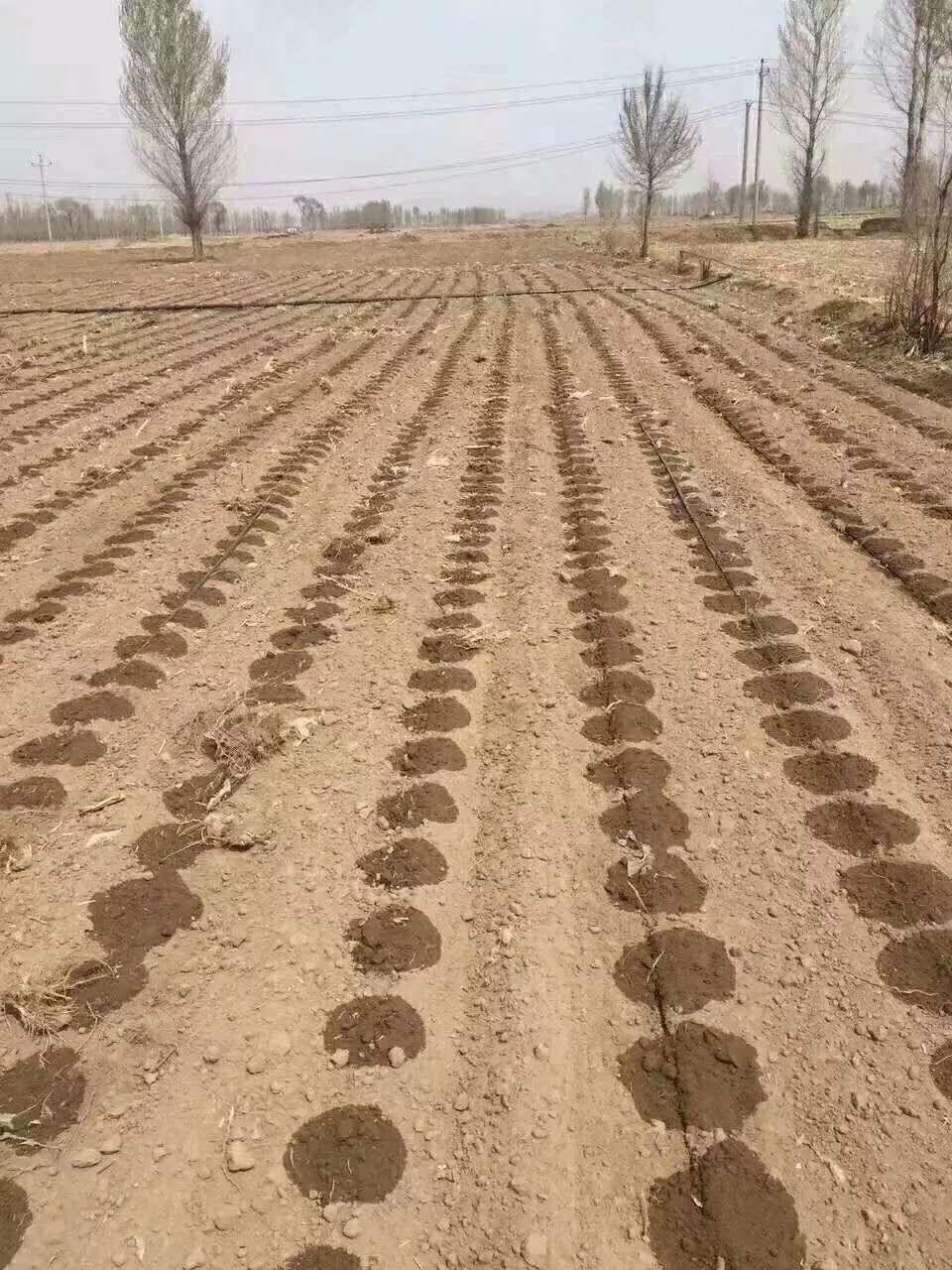
Sprinkler irrigation tape is a new type of micro-irrigation equipment, also known as “micro-sprinkler tape,” “water-spraying tape,” “micro-sprinkler hose,” “sprinkler pipe,” or “porous flexible hose,” among other names; it is widely used.
Thin-wall sprinkler tape is a water-saving micro-jet irrigation pipe formed by thermally sealing pinhole outlets—configured as “raft”-type pressure-reducing channels—along one side or the middle of the pipe. Micro-sprinkler systems are typically used for agricultural irrigation and are now also employed in landscape gardening and maintenance.
Commonly used sprinkler tape: diameter of 32 mm; length of 80 m; spray coverage width of 100–120 cm.
The working principles and characteristics of several commonly used temporary spraying methods;
01 Rocker-Type Spraying Device
(1) Operating principle:
Long- and medium-range oscillating-arm sprayer, water-impulse driven, with stable operation. Features a reverse gear and offers full-coverage or adjustable fan-pattern spraying.
A rocker arm is fitted onto the rocker-arm shaft above the nozzle, with a deflector (water baffle) and guide vane at its front end. When pressurized water exits the nozzle, it strikes the deflector and guide vane, generating a tangential force that causes the rocker arm to rotate about its cantilevered support through a certain angle. Subsequently, under the action of a torsion spring, the rocker arm returns to strike the nozzle again, causing the nozzle to rotate through another angle. If this cycle is repeated, the nozzle can achieve a full circumferential rotation.
(2) Advantages:
(1) Long service life, approximately 10 years;
② The spray coverage can be adjusted flexibly;
③ Long range and flexible adjustment;
④ The bidirectional effect of surface wetting and leaf cooling;
⑤ Each nozzle can be controlled independently.
(3) Disadvantages:
(1) Highly susceptible to wind and water pressure;
(2) High water pressure is required, the nozzles are prone to clogging, and maintenance workload is substantial;
③ Prone to blind spots;
(4) Uneven water discharge can easily lead to localized ponding;
⑤Higher cost: Based on a 100 m² area, material costs are approximately RMB 100–150.
02 drip irrigation sprinkler
(1) Operating principle:
Drip irrigation involves using drip emitters installed on pipelines or drip tapes integrated with capillary tubes to moisten the soil. The flow rate of drip emitters typically ranges from 2 to 12 liters per hour. In this irrigation technique, water is delivered through main lines, lateral pipes, and emitters on capillary tubes, slowly dripping into the soil under low pressure. It constitutes an irrigation system that directly supplies filtered water, fertilizers, or other chemical substances to the soil.
(2) Advantages:
(1) Uniform water discharge;
② Suitable for precision management in nurseries and greenhouses.
(3) Disadvantages:
(1) Small operating radius;
② The nozzle is prone to clogging;
③ Low installation efficiency and high installation costs;
(4) The cost is relatively high, with material costs amounting to approximately RMB 200–250 per 100 m².
Hebei Runtian Water-Saving Equipment Co., Ltd. is a manufacturer of drip irrigation tape, drip irrigation tubing, and PE drip irrigation pipe. Its main products include ground-insert micro-sprinklers, automated drip irrigation systems, suspended micro-sprinklers, field drip irrigation, field sprinkler irrigation, fruit-tree drip irrigation, greenhouse drip irrigation, irrigation PE pipe, subsurface drip irrigation, intelligent fertilizer applicators, integrated water-fertilizer machines, and sprinkler irrigation tape. The company is a comprehensive enterprise that integrates research and development, production, sales, and engineering installation of plastic irrigation products. Adhering to a people-oriented approach and a commitment to innovation, the company has established a new business philosophy centered on promoting water-saving irrigation equipment and technologies tailored to China’s national conditions. It strives to expand both domestic and international markets, enhance its service system, and continuously strengthen and grow its marketing network. We welcome you to consult with us and discuss potential collaborations.
Keywords:
Recommended News
2026-04-08
How should hanging micro-sprinklers be properly installed to ensure optimal irrigation performance?
2026-03-29
How does irrigation technology using suspended micro-sprinklers improve crop water-use efficiency?
2026-03-19
The applications of ground-inserted micro-sprinklers are not limited to agricultural fields.
2026-03-09
How to Select the Right Underground Micro Sprinkler Nozzle to Enhance Irrigation Efficiency
2026-02-27
Share to


Contact Information
Email:1468828465@qq.com
QQ number: 1468828465
Phone:18348888811
Phone:0311-89271615
Website:www.hebeiruntian.com
Factory Address: Dasun Village, Luancheng District, Shijiazhuang City, Hebei Province

WeChat Official Account