

Greenhouse Drip Irrigation System Installation


Release Date:

2019-08-29

When implementing drip irrigation inside greenhouses, each greenhouse is typically equipped with outlet ports. Filtration and fertilization units can be connected directly to these outlets. The following section provides a detailed description of how pipe fittings and equipment are connected. Based on the greenhouse’s area, divide the irrigation zones into appropriately sized rotational irrigation groups. Select a main pipeline material with a pipe diameter that is both economically efficient and capable of meeting the required irrigation water demand. Begin by installing the headworks of the entire drip irrigation system. Starting from the outlet end of the PE supply pipe, first connect a PE male-threaded compression fitting to a corresponding model of PVC female-threaded ball valve. Since both the PVC female-threaded ball valve and the Venturi fertilizer injector are female-threaded fittings, a metal connector can be used.
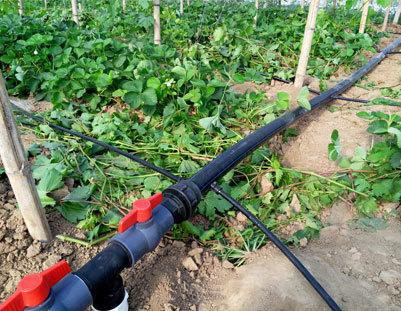
When implementing drip irrigation inside greenhouses, each greenhouse is typically equipped with outlet ports. Filtration and fertigation systems can be connected directly to these outlets. The following section provides a detailed description of the connections for piping and associated equipment.
Based on the greenhouse area, reasonably delineate irrigation rotation groups. Select a pipe material for the main pipeline that offers a pipe diameter that is both economically viable and capable of meeting the required irrigation water demand.
First, install the head assembly of the complete drip irrigation system. Starting from the outlet end of the PE pipe, connect a PE male-threaded straight connector to a PVC female-threaded ball valve of the corresponding model. Since both the PVC female-threaded ball valve and the Venturi fertilizer injector are female-threaded fittings, they can be joined using a steel coupling with matching threads. To ensure a tight seal, wrap an appropriate amount of Teflon tape around the threaded connection. On the other side, tightly screw the mesh filter (or disc filter)—which is a male-threaded fitting—onto the Venturi fertilizer injector. Finally, secure the male-threaded mesh (or disc) filter to the PE pipe using a PE female-threaded locknut straight connector. With this, the complete head assembly has been fully installed.
After the water-delivery pipeline is connected at the headworks, it is routed according to the irrigation zoning. Within greenhouse structures, PE pipe (or PVC pipe) may be used for the main delivery line; typically, no trenching is required inside the greenhouse, and the pipe is laid directly on the ground. Branch lines generally use PE pipe or flexible tubing, which facilitates perforation for connection to drip irrigation tape or tubing.
Finally, the end-of-line irrigation emitters are installed; commonly used options include drip tape or drip tubing. For greenhouses that use PE pipe as the lateral main and drip tape for drip irrigation, first use a hole-punching tool of the appropriate size (Φ16) to make holes in the PE pipe, then install a pull-ring bypass fitting or a female (or male) bypass fitting, and finally connect the drip tape to the bypass fitting. Alternatively, fittings with built-in valves can be used, which offer more convenient control during operation. The end of the drip tape can be sealed with a pull-ring end cap, or it can simply be cut off. Drip irrigation tape Fold the end of the drip irrigation tape several times and then tuck it into the cut section of the tape for a more convenient connection.
 Strawberry drip irrigation

Keywords:


Recommended News


Case Study on the Application of Suspended Micro-Sprinklers in Greenhouse and Field Micro-Drip Irrigation

Case Studies on the Application of Suspended Micro-Sprinklers in Greenhouse and Field Micro-Drip Irrigation In modern agriculture, the efficient use of water resources is crucial for enhancing crop yield and quality. Suspended micro-sprinklers, as an emerging irrigation technology, have gradually become a popular choice for greenhouse and field micro-drip irrigation systems thanks to their precise moisture control and flexible installation options. Today, we will explore several real-world applications of suspended micro-sprinklers and examine how they are transforming the landscape of agricultural irrigation. What Are Suspended Micro-Sprinklers? Suspended micro-sprinklers are micro-irrigation devices that are mounted at a specific height using a suspension system. They deliver water in the form of fine droplets, evenly spraying it over crops, which not only improves water-use efficiency but also effectively reduces the incidence of plant diseases. Compared with traditional irrigation methods, suspended micro-sprinklers offer distinct advantages, particularly in greenhouse and field applications, where their unique value is fully realized. The Advantages of Using Suspended Micro-Sprinklers Imagine an artist delicately applying brushstrokes to create a perfect masterpiece—suspended micro-sprinklers, in turn, provide precise moisture delivery to support crop growth. First, they ensure uniform water coverage, allowing every plant to receive adequate hydration. Second, the suspended design enables water droplets to reach the plant roots directly, minimizing water loss. And

2026-04-08

How should hanging micro-sprinklers be properly installed to ensure optimal irrigation performance?

How to properly install hanging micro-sprinklers to ensure optimal irrigation performance? In modern agriculture and horticulture, the design and installation of irrigation systems are of paramount importance. Hanging micro-sprinklers, in particular, have increasingly become the preferred choice for many farmers and gardening enthusiasts due to their ability to deliver uniform spray irrigation. So, how can these hanging micro-sprinklers be installed correctly to achieve the best possible irrigation results? Today, let’s explore this topic in depth. Understanding the Basic Principles of Hanging Micro-Sprinklers Before we begin installation, it’s essential to first grasp how hanging micro-sprinklers work. They atomize water through nozzles, producing fine droplets that evenly cover the plant surface. This method of spray irrigation not only effectively reduces water evaporation but also minimizes water waste, ensuring that plants receive the moisture they need. Preparatory Steps: Choosing the Right Site Before installing hanging micro-sprinklers, selecting an appropriate site is crucial. Several factors should be taken into account: 1. Plant Species: Different plants have varying water requirements; understanding these needs will help determine the proper installation height and number of sprinklers. 2. Topography: The terrain affects the distribution of water flow, so it’s important to ensure a level ground to prevent water from pooling on one side. 3. Drainage System: If the site has poor drainage, water may accumulate, leading to root rot.

2026-03-29

How does irrigation technology using suspended micro-sprinklers improve crop water-use efficiency?

How Does Suspended Micro-Sprinkler Irrigation Enhance Crop Water Use Efficiency? In modern agriculture, the rational use of water resources is of paramount importance. As droughts and water shortages become increasingly severe, traditional irrigation methods can no longer meet the demands of high-efficiency farming. This is where suspended micro-sprinkler technology comes into play: it not only uses water more efficiently but also improves crop growth quality. So how exactly does the suspended micro-sprinkler system boost crop water-use efficiency? What Is a Suspended Micro-Sprinkler? To begin with, let’s take a closer look at what a suspended micro-sprinkler is. Simply put, it is an irrigation device that evenly distributes water across farmland through tiny spray nozzles, producing a fine mist. The sprinklers are suspended above the crops, allowing the misty droplets to fall directly onto the leaves and roots. The advantage of this approach is that the moisture penetrates the soil more effectively while minimizing evaporation losses. High-Efficiency Water Use You may be wondering: why choose suspended micro-sprinklers over conventional irrigation methods? The answer lies in water-use efficiency. Traditional irrigation often results in substantial evaporation and runoff, whereas the atomizing spray technique employed by suspended micro-sprinklers significantly reduces these losses. Studies have shown that irrigation systems using suspended micro-sprinklers can increase water-use efficiency by

2026-03-19

The applications of ground-inserted micro-sprinklers are not limited to agricultural fields.

The applications of ground-insert micro-sprinklers extend far beyond agricultural irrigation in fields; their presence has become indispensable. When people think of micro-sprinklers, the first thing that comes to mind is often irrigating farmland—indeed, this is one of their primary uses. But did you know that the scope of ground-insert micro-sprinkler applications goes much further? Today, we’ll explore the diverse ways these devices can be used, challenging the conventional notion that they exist solely for farming. The Basic Concept of Ground-Insert Micro-Sprinklers Before diving into specific applications, let’s first clarify what a ground-insert micro-sprinkler is. As the name suggests, it is a device designed to be directly inserted into the soil for irrigation. Its fine water droplets are distributed as evenly as a gentle rain, providing plants with the moisture they need while minimizing water loss through evaporation. This precise method of irrigation significantly enhances water-use efficiency. Applications Beyond Farmland Many people may wonder: “Can ground-insert micro-sprinklers really be used anywhere other than fields?” The answer is yes! Let’s take a look at some of their alternative applications. 1. Gardens and Courtyards Imagine a sunny afternoon, sitting on a swing in your own garden surrounded by lush, vibrant plants. When it comes to watering these plants, using a ground-insert micro-sprinkler is like adding wings to a tiger. It helps you evenly

2026-03-09

How to Select the Right Underground Micro Sprinkler Nozzle to Enhance Irrigation Efficiency

How to Choose the Right In-Ground Micro Sprinkler to Boost Irrigation Efficiency In modern agriculture and horticulture, improving irrigation efficiency is a key goal for every farmer and gardening enthusiast. Among the many irrigation tools available, in-ground micro sprinklers stand out for their high efficiency—but selecting the right model can often be confusing. Today, we’ll explore how to choose the ideal in-ground micro sprinkler to help you enhance your irrigation performance. A Basic Understanding of In-Ground Micro Sprinklers First, let’s clarify what an in-ground micro sprinkler is. It’s a type of sprinkler installed directly in the soil that delivers water in tiny droplets, targeting the plant roots while minimizing evaporation and water loss. Think of it like having a little umbrella in your garden: whenever your plants need moisture, it gently releases a fine mist—sounds pretty nice, doesn’t it? Key Factors to Consider When Choosing the Right In-Ground Micro Sprinkler When selecting an in-ground micro sprinkler, there are several important factors to keep in mind: 1. Sprinkler Flow Rate Different in-ground micro sprinklers have varying flow rates, typically measured in liters per hour (L/h). You should choose a flow rate that matches your plants’ water requirements. Imagine your plants as sponges thirsting for moisture, and the sprinkler’s flow rate as the amount of water coming out of the faucet—only when the two are properly matched can you achieve optimal results.

2026-02-27

Share to